The bank has confirmed that the wire transfer was successfully completed. Over more than a decade, nearly $200,000 was lost. Promises of market returns, urgent clearance fees, and compliance costs—all were false, with the perpetrators using Chinese bank accounts to create an appearance of legitimacy. Now, from halfway across the world, where does one even begin to seek justice?
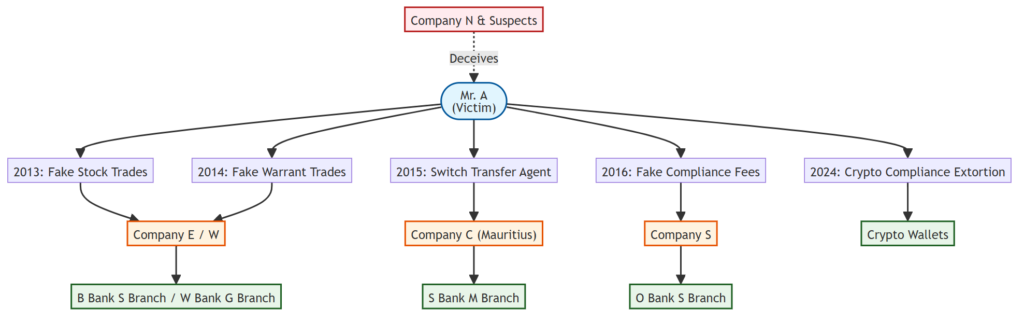
This is not a hypothetical scenario. It reflects the real experience of one of our recent clients, Mr. A, an middle east country national who was systematically defrauded by an entity posing as a legitimate asset management firm, N Limited. Between 2015 and 2024, this entity employed a sophisticated network of emails, forged documents, and a series of shell companies in China, Hong Kong, and Mauritius to extract approximately USD 200,000 from Mr. A to the fraud was the use of Chinese bank accounts—specifically at the S City Bank where Mr. A was instructed to wire funds under the pretense of third-party escrow or transfer agents.
Mr. A case exemplifies a modern challenge: a foreign victim targeted by a fraud with significant ties to China must navigate a complex and often opaque legal environment to seek recovery. This guide is intended for you, the foreign national who may face a similar situation.
I. Understanding the Importance of Telecom Fraud Case to Chinese Authorities
A key question you may have is whether Chinese law enforcement has the authority to investigate a fraud case in which you, as a foreigner, are the victim. The answer is not simply yes or no; it requires a clear understanding of how Chinese criminal jurisdiction works, which is essential for effectively addressing your case.
Chinese law primarily establishes jurisdiction based on two principles relevant to cross-border fraud:
Territorial Jurisdiction (属地管辖): This is the most significant factor in your situation. According to Article 6 of China’s Criminal Law, the law applies to any crime committed within the territory of the People’s Republic of China. Importantly, a crime is considered to have occurred in China if either the criminal act or the criminal outcome takes place within its borders.
- Criminal Act: If any part of the fraudulent activity—such as operating servers, managing the fraudulent website, sending deceptive emails, or coordinating fund collection—was carried out by individuals physically located in China, this constitutes a criminal act within Chinese territory. For example, in Mr. A case, the perpetrators used a website listing S and B city office addresses, and emails were sent from servers potentially based in China.
- Criminal Result: The criminal result in fraud involves the victim’s financial loss and the perpetrator’s illegal gain. A critical factor is the possession of stolen funds. If the stolen money was transferred to and received in bank accounts within China, as with Mr. A funds wired to two banks in S city, this establishes a key element of the crime occurring on Chinese soil, reinforcing jurisdiction.
Personal Jurisdiction (属人管辖): Article 7 of the Criminal Law also grants China jurisdiction over crimes committed outside its borders by Chinese nationals. If the fraudsters are Chinese citizens, China can prosecute them regardless of where the fraud took place. While this is often a secondary argument, it complements the stronger territorial jurisdiction based on the funds being received in China.
Practical Considerations: You may find that some police officers are hesitant or unfamiliar with taking jurisdiction over cases involving foreign victims and cross-border elements. They might initially consider such matters as international and better handled through diplomatic channels. This is where skilled legal representation becomes crucial.
We don’t just assert that jurisdiction exists; we build a strong, legally sound case supported by Supreme Court interpretations and directives from the Ministry of Public Security. We demonstrate that the receipt and management of your stolen funds in Chinese bank accounts clearly establish the crime’s occurrence in China, thereby obligating local authorities to take action. In this way, we turn potential jurisdictional doubts into a clear legal responsibility for the police to investigate your case.
II. Acting Swiftly: Immediate Steps Upon Discovering Fraud
Once you become aware that you have been defrauded, time is of the essence. The first 48 hours are crucial to increasing the likelihood of freezing the stolen funds before they are dispersed across multiple accounts or converted into other assets.
A. Reach Out to the Chinese Receiving Bank Without Delay
If you know the name of the Chinese bank where your funds were transferred, promptly contact their fraud or compliance department. Although you may not have the authority to request a freeze directly, your notification can often activate the bank anti-money laundering (AML) or anti-fraud procedures, potentially resulting in a temporary hold on the suspicious account while an investigation is conducted.
B. Submit an Emergency Stop Payment (紧急止付) Request via Chinese Police
This is the most effective immediate measure available. Under China Notice on Establishing an Emergency Stop Payment and Rapid Freezing Mechanism for Accounts Involved in Telecom and Network Fraud, victims can initiate a freeze on the suspected receiving account even before a formal criminal case is filed.
How it works: You or your legal representative report the fraud to a local Chinese police station, either by phone or in person, providing essential information such as your name, the suspected account number, the account holder’s name (if known), and the amount transferred. The police then enter this information into a national platform, which sends an electronic Emergency Stop Payment Instruction to the receiving bank headquarters. The bank is required to immediately suspend all outgoing transactions from that account.
Timing: The initial stop payment lasts for 48 hours. During this period, the police will review the case and, if supported by the evidence, formally open a criminal investigation (立案) and issue an official Assist in Freezing Property Notice, which extends the freeze.
III. Filing a Formal Criminal Report (刑事报案): Establishing a Strong Case
The emergency stop payment serves as a temporary measure. To pursue long-term recovery and criminal prosecution, it is essential to file a formal criminal report (报案). This process is complex and requires meticulous attention to evidence and detail to build an irrefutable case.
A. Reporting Location
According to the principle of territorial jurisdiction, reports should be submitted to the Public Security Bureau (PSB) Economic Crime Investigation Department (经侦总队) in the city where the recipient bank account is held. While it is also possible to report to the local police station (派出所), they often lack the specialized expertise and authority to manage complex cross-border financial crimes and typically escalate the case to higher authorities.
B. Crafting an Effective Criminal Report
An effective criminal report goes beyond a simple complaint; it serves as a prosecutorial document that provides law enforcement with a clear, legally grounded case theory, well-organized evidence, and specific action requests. We prepared Mr. A report following this comprehensive structure:
Parties Information: We clearly identified the victim (including a notarized copy of the passport), the suspected criminal entities (shell companies), and the individuals involved (named officers of the fraudulent firm). We also included their last known addresses, email contacts, and website details.
Factual Narrative: We presented a detailed, chronological account of the fraud, divided into key phases:
- Initial Trust Building: How the perpetrator established legitimacy by presenting a Chinese presence with Beijing/Shanghai addresses, Chinese phone numbers, and a professional website.
- The Inducement: Specific trades and fabricated documents (Trade Confirmations, Bank Instructions) used to persuade Mr. A to transfer funds.
- The Extraction Mechanism: A critical section explaining that Mr. A was never instructed to pay the supposed firm directly but was directed to third-party escrow or transfer agents. This tactic created a façade of legitimate corporate structures to obscure the true orchestrators.
- The Continuation: The ongoing demands over subsequent years for additional payments under false pretenses—such as Tax Bonds, Personal Identity Clearance fees—resulting in further transfers to new shell company accounts located in China, Mauritius, and Hong Kong.
- The Finality: Demonstrating the complete lack of any return of principal or profit, establishing the perpetrator intent for illegal possession (非法占有目的).
Evidence Presentation: Rather than merely listing documents, we compiled an indexed evidence booklet linking each piece of evidence to specific factual claims. This included:
- Correspondence: Email printouts documenting the entire communication chain, from initial solicitations to the final, unanswered requests for fund returns.
- Financial Documents: Bank instructions detailing the exact account numbers and SWIFT codes where funds were transferred, along with payment receipts from the perpetrators confirming receipt.
This structured approach ensures clarity and legal rigor, facilitating effective investigation and prosecution.
C. Overcoming the Key Challenge of Jurisdiction
One of the most significant obstacles you may encounter is the issue of jurisdiction. When approaching a Chinese police station—especially without experienced local legal counsel—you might initially face a polite but firm refusal. Authorities may contend that since the victim is foreign and the communication originated outside China, the crime falls outside their jurisdiction. This reflects a common misunderstanding of Chinese criminal law, which we are prepared to challenge effectively.
According to Article 6 of the Criminal Law of the People’s Republic of China, the law applies to all crimes committed within Chinese territory. A crime is deemed to have occurred within China if either the criminal act or its result takes place there. In cross-border fraud cases, the criminal result is the illegal acquisition of your funds by the perpetrator. The critical question is: where did this result occur? The answer depends on the flow of the money.
If you, as a foreign victim, transferred funds to a bank account located in China—whether an OSA account, an NRA account, or a standard domestic account—the criminal result occurred on Chinese soil. The Supreme People’s Court and the Ministry of Public Security have affirmed this principle. Jurisdiction is based not on where the victim was deceived but on where the suspect actually received the illicit funds. Therefore, the moment your money was credited to a Chinese account, the local public security bureau is obligated to accept the case.
In Mr. A case, we presented a robust jurisdictional argument to the local Public Security Bureau; we highlighted multiple connections to China: the perpetrators office addresses in B and S city, use of +86 telephone numbers, and, most importantly, instructions for the victim to remit funds into S city-based bank accounts. The receipt of substantial funds into these accounts constituted the criminal result in S city. By combining legal provisions with a detailed table of implicated bank accounts and their S city SWIFT codes, we eliminated any doubt about territorial jurisdiction.
We also address the complexities of cyber connection claims. While some law enforcement units may overextend jurisdiction by asserting that accessing a server from within China constitutes a crime, we focus on the concrete movement of funds into Chinese financial institutions. This tangible evidence anchors the case firmly within Chinese jurisdiction.
III. Understanding the Chinese Banking System and NRA Accounts
A clear grasp of how fraudsters exploit the Chinese banking system is vital for effective recovery. Recently, cross-border telecom fraud often involves Non-Resident Accounts (NRA), which are foreign currency accounts intended for overseas institutions conducting legitimate business in China. Fraudsters misuse these accounts as channels for illicit funds.
Typically, the stolen money follows this path: the fraudster sets up a shell company in an offshore jurisdiction with lax disclosure laws (e.g., British Virgin Islands, Mauritius, Hong Kong). This company opens an NRA account at a Chinese bank. The victim wires money into this NRA account, after which the fraudster quickly transfers funds to a domestic foreign exchange account under their control. The money is then converted into Renminbi and dispersed through multiple domestic accounts to obscure its trail.
Because of this rapid movement, acting quickly is crucial. If the fraud is detected while funds remain in the NRA or primary receiving account, there is an opportunity to freeze them. Once dispersed into multiple secondary accounts, recovery becomes far more complex, requiring extensive tracing and multiple freeze orders.
IV. Leveraging Regulatory Intervention and Alternative Strategies
While initiating a criminal case is often the most direct route to asset recovery, other strategies can be equally effective. China financial system is highly regulated, with banks subject to strict anti-money laundering and compliance obligations. When banks fail in these duties, they can be held accountable—a leverage point we use to facilitate fund recovery.
Engaging regulatory bodies such as the People’s Bank of China, the State Administration of Foreign Exchange, and the National Financial Regulatory Administration can complement criminal proceedings. Demonstrating that a bank failed to properly verify NRA account holders, authenticate trade documents, or report suspicious transactions exposes the bank to severe penalties, including fines and suspension of foreign exchange operations. To mitigate these risks, banks may cooperate with fraudsters to return funds.
This approach is particularly relevant for NRA accounts, where banks must conduct thorough due diligence on overseas entities. If a shell company with no real operations was approved without proper checks, the bank breaches regulatory obligations. By filing formal complaints or legal letters with regulators, we can trigger investigations that aid in tracing funds and provide evidence for litigation against negligent banks.
V. Essential Legal Tools: Preservation and Investigation Orders
In cross-border asset recovery, knowledge is power. Identifying where the money went is a prerequisite to reclaiming it. The Chinese legal system offers powerful tools—property preservation orders and lawyer investigation orders—that experienced legal teams can use to uncover facts and secure assets.
A property preservation order functions like a freezing injunction, preventing defendants from disposing of assets during litigation. This is critical to ensure that assets remain available to satisfy judgments in civil claims. Courts can freeze bank accounts, real estate, vehicles, and other property owned by fraudsters or their shell companies. Foreign victims face challenges such as providing security for the order and acting swiftly to prevent asset movement.
The lawyer investigation order compels third parties—banks, telecom companies, government registries—to disclose otherwise confidential information. In fraud cases, lack of information is a major hurdle. While you may know the initial receiving account, subsequent transfers often remain hidden. With a court-issued investigation order, we can obtain complete transaction histories, trace funds through multiple accounts, and identify account holders.
VI. The Importance of Specialized, Local Expertise
Cross-border financial fraud involves complex legal, procedural, and linguistic challenges. Navigating this landscape without specialized local counsel familiar with China legal system often leads to frustration and failure. Mr. A case exemplifies the comprehensive approach needed to achieve justice. From the outset, we recognized this was a sophisticated, long-term deception exploiting international trust and banking complexities. We reconstructed the scheme legally, identifying specific criminal violations under the PRC Criminal Law, as well as potential money laundering and forgery offenses. We proactively employed strategies including emergency stop-payment orders, regulatory complaints, and civil litigation preparations, utilizing every available legal tool.
Victims of international fraud need more than a lawyer—they need an advocate who understands their situation, communicates effectively with local authorities, and has a proven track record in cross-border fraud recovery. The path to recovery in China is complex but achievable with the right guidance.