For foreign corporations doing business in China, as well as for expatriate executives and individuals, the possibility of finding oneself caught up in China’s criminal justice system can be deeply unsettling. The way proceedings are handled, the rights afforded to the accused, and the available means of defense in China are fundamentally different from those in common law countries or other Western legal systems. When a foreign national or a foreign-invested company is subject to a criminal investigation in China—whether the allegations involve commercial bribery, embezzlement, smuggling, theft of intellectual property, or tax evasion—the risks are extremely high. The result of the case affects far more than the personal freedom of those involved; it also determines the company’s ability to continue operating and its reputation in the market.
In these high-pressure situations, foreign entities are often misled into thinking they can simply wait for the investigation to resolve itself, or that diplomatic efforts will fix the issue. That assumption is a serious and potentially disastrous error. China’s criminal process is governed by strict statutory timelines that cannot be bargained with, and the actions taken in the earliest phase of the investigation frequently shape the ultimate outcome of the case. Time is not just a scheduling concern—it is the single most important factor in building a strong, favorable defense.
The goal of this guide is to clarify the Chinese criminal process for foreign enterprises and individuals. By breaking down the three core stages of a criminal case—investigation, review and prosecution, and trial—we aim to offer a clear, measurable picture of what an effective and rigorous legal defense involves in China.
The Crucial First Phase: The Investigation Stage and the Golden 37 Days
In China, the investigation stage is carried out by the public security organs—what most people would recognize as the police. This period is focused on collecting evidence and building a clear factual picture of the crime the suspect is accused of. For the accused, this is also the most important window to act quickly. In Chinese legal practice, it is often called the golden 37 days. If a foreign individual or organization is trying to navigate this system, it is vital to understand exactly how this timeline works.
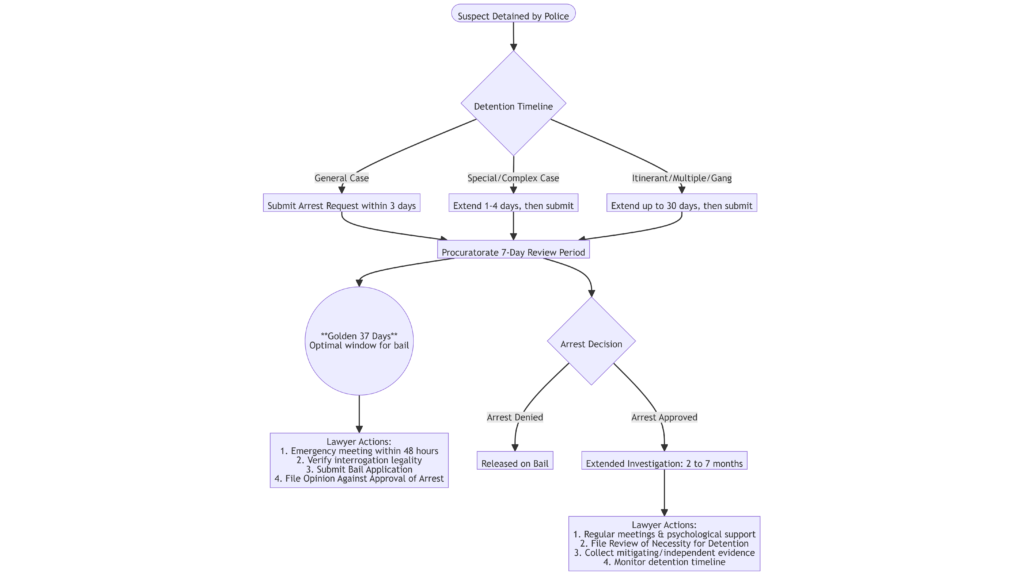
The detention process begins with strict time limits. In general, once the police detain a suspect, they must submit a request for formal approval of arrest to the People’s Procuratorate (the prosecuting authority) within three days. In certain special situations—especially where the case is unusually complicated—the police may extend the detention period by an additional one to four days, but only with approval from an official at the county level or higher. For suspects connected to itinerant offenses, multiple offenses, or gang-related crimes, the detention period can be extended up to a maximum of 30 days.
After the police submit the request for formal arrest, the People’s Procuratorate has exactly seven days to review the case and issue a binding decision—either approving the arrest or denying it. Add the maximum police detention period of 30 days to the seven-day review period, and you get the 37-day window. This is the absolute golden period for seeking release on bail. If the suspect remains in custody beyond that point without bail being granted, the chances of arrest approval become extremely high. Once a formal arrest is approved, the obstacles to securing release increase dramatically, and prolonged detention can quickly become a grim reality.
During these golden 37 days, hiring a specialized criminal defense lawyer is not optional—it is essential. Foreign entities should understand that in China, a lawyer does not simply watch what happens. A capable legal representative must take decisive, tangible steps. Within 48 hours of being retained, the lawyer must arrange an emergency meeting with the detained person. This meeting is crucial for several reasons: it allows the lawyer to confirm the facts, review the details of any interrogations, and identify any possible illegal handling of evidence, such as coercion or inducement. Just as importantly, the lawyer must immediately brief the suspect on their core rights—especially the right to carefully review and correct interrogation transcripts, the right to refuse to sign inaccurate statements, and the constitutional protection against being forced to incriminate oneself. The psychological pressure during this period is intense, and without professional guidance, suspects often end up making rushed admissions that cause lasting damage.
At the same time, the lawyer must actively work with the investigating authorities. By submitting formal documents proving the legal representation, the lawyer creates a direct communication channel with the police to learn the exact charges, the nature of the allegations, and the overall direction of the investigation. The lawyer must then submit a formal Application for Bail Pending Trial before the 30-day deadline, and during the procuratorate’s seven-day review period, file a strong Written Opinion Against Approval of Arrest. These documents must carefully argue that the suspect poses no danger to society. They should also emphasize relevant factors, such as whether this is a first-time or occasional offense, and present any proof of restitution or victim forgiveness. The main goal is to stop formal arrest from being approved under any circumstances.
If, despite these efforts, the arrest is approved, the investigation continues—but the defense strategy cannot slow down. After arrest, detention can last up to seven months, depending on the complexity and seriousness of the case. The statutory baseline for post-arrest investigation is two months, but it may be extended by one additional month in complex cases, by two more months for major complex cases in remote areas, and by a final two months if the suspect might face a sentence of 10 years or more. Throughout this extended period, a diligent lawyer should keep meeting regularly with the accused, track how the evidence evolves, and help maintain the person’s psychological stability. Most importantly, the lawyer must file a Review of the Necessity for Detention in order to seek post-arrest bail. They must also independently collect evidence that supports innocence, reduced culpability, voluntary surrender, or meritorious service. All the while, the lawyer must strictly monitor the detention timeline to prevent unlawful or extended imprisonment.
The Second Phase: Examination and Prosecution—The Battlefield of Evidence and Non-Prosecution
Once the police finish their investigation, the case moves to the People’s Procuratorate for review and prosecution. This is the pivotal phase of the entire criminal process. It’s during this step that the procuratorate decides whether the evidence is strong enough to go to trial, whether the charges are properly supported and accurately framed, and—most importantly—whether to indict the suspect or dismiss the case altogether. For foreign enterprises, this stage is often the clearest—and sometimes the final—real chance to get the matter dismissed completely, without ever reaching a courtroom.
The procuratorate generally has one month to complete its review. For major or complicated cases, that period may be extended by an additional 15 days, but it cannot exceed 1.5 months in total. That said, if the procuratorate concludes the evidence is insufficient, it can send the case back to the police for supplementary investigation. This type of supplementary investigation may be ordered no more than two times, and each round can last up to one month. After each remand, the review timeline starts again from the beginning. In particularly serious or difficult situations, the entire process at this stage can stretch to as long as 6.5 months. While that sounds like a long delay, these supplementary investigation rounds are actually crucial opportunities for the defense. If, after two rounds, the evidence still fails to meet the standard needed to support the charges, the procuratorate is legally required to issue a decision of non-prosecution due to lack of sufficient evidence. That is the defense’s ultimate objective: a full stop to the case, leaving no criminal record and restoring the individual’s freedom.
To obtain a non-prosecution outcome, or at least achieve a highly favorable sentencing recommendation, a defense lawyer must carry out a range of rigorous, specialized tasks. The most basic—and absolutely essential—step is a thorough review of the case file. In the Chinese system, this is where the real work and real leverage lies. A lawyer who doesn’t carefully examine the case materials is not genuinely defending the client. The lawyer must go through the entire dossier in detail, make complete copies, and scrutinize every item of evidence for legality, authenticity, and relevance. They also need to identify contradictions, procedural defects, and any evidence that was obtained illegally, then compile all findings into a detailed case review memorandum.
After reviewing the file, the lawyer must hold in-depth, evidence-focused meetings with the accused. With the case materials in hand, the lawyer will systematically test the suspect’s statements, the witnesses’ testimony, and the conclusions of any expert assessments, checking them line by line against the record. This step is vital for locking in the defense strategy—whether the goal is to argue for innocence, push for a lesser charge, or negotiate for a reduced sentence.
At the same time, the lawyer must also collect mitigating evidence, such as victim statements of forgiveness, proof of restitution, community evaluations, or medical records. They can also request that the procuratorate gather evidence the police may have missed—for example, surveillance footage, communication logs, or witness testimony that supports the defense.
In addition, if the accused chooses to admit guilt and accept punishment—under the “leniency for pleading guilty and accepting punishment” procedure—the lawyer must provide objective, professional guidance. This is not a simple formality. The lawyer must weigh the advantages and disadvantages, ensure the confession is fully voluntary and legally valid, and negotiate with the prosecutor to obtain the greatest possible benefit. The lawyer must never pressure or coerce the client into signing any agreement, but must instead use negotiation strategically to secure the most favorable sentencing recommendation possible. The final part of this phase is submitting a high-quality, comprehensive written defense opinion that lays out the case facts, evidence, legal application, and sentencing considerations from a broad, multi-dimensional perspective—while actively engaging the prosecutor to adopt the defense’s viewpoint.
The Third Phase: The Trial Stage—The Final Decisive Confrontation
If the procuratorate decides to indict, the matter formally shifts into the trial stage and comes under the People’s Court’s authority. At this point, the proceedings are organized into the first instance trial (the initial hearing) and, if it becomes necessary, the second instance trial (the appeal). In practice, the trial stage is where legal arguments are put to the test and where the final verdict is determined.
For the first instance trial, the law sets a basic time limit of two months from the date the case is accepted, which may be extended to three months. For cases where a death sentence may be imposed, for incidental civil lawsuits, or for major and complicated cases located in remote areas, the court may further extend the period by three months, but only with approval from the higher court. In exceptional circumstances, with approval from the Supreme People’s Court, the trial period may be extended up to a maximum of six months. In simpler cases, expedited procedures can lead to a judgment within as little as 10 to 15 days, which makes it especially important for the defense to prepare immediately and take initiative.
A strong defense in the first instance depends on extensive preparation before the trial begins. The lawyer must review the case materials again and compare whether the evidence has changed since the prosecution stage. Regular meetings with the accused are needed to run trial simulations, so the individual is ready for interrogation, cross-examination, and debate during the hearing. The lawyer must also carefully compile evidence inventories, draft cross-examination plans, and refine the overall defense strategy.
Before the trial starts, the lawyer must file essential applications, including renewed requests for bail, motions to exclude illegally obtained evidence, and requests for key witnesses or forensic experts to testify in court. These measures are fundamental to building a firm defensive foundation. During the trial itself, the lawyer must mount a substantive defense: cross-examine the prosecution’s evidence rigorously and present convincing legal arguments, rather than only reading a prewritten statement. After the trial concludes, the work is not finished. The lawyer must submit a detailed written defense brief, explain the defense’s core arguments to the judges, and ensure that the client clearly understands the verdict and their rights regarding an appeal.
If the first instance verdict is unfavorable, the appellate stage is the final opportunity to seek reversal. The statutory deadline for filing an appeal is extremely short—10 days from receiving the judgment, and 5 days from receiving a ruling. If the defense misses the deadline, the verdict becomes final and enforceable, and any later challenges will become increasingly difficult. As a general rule, the second instance court must conclude the appeal within two months, with up to an additional two months permitted for major complex cases, and no more than seven months in exceptional circumstances, subject to approval by the Supreme People’s Court.
During the appeal stage, the defense lawyer must draft and submit the appeal petition within the strict deadline, leaving no room for mistakes. The lawyer must conduct a thorough re-check of the entire case file and search for problems such as errors in fact-finding, shortcomings in evidence assessment, failures to follow required procedures, or incorrect application of law by the first instance court. The lawyer should also meet with the appellant to confirm the grounds for appeal and present any newly discovered evidence. Whether the appeal is handled through a formal courtroom hearing or reviewed through written submissions, the lawyer must advocate forcefully for either overturning the verdict or remanding the case for a new trial.
Evaluating Legal Representation: The Standard of Diligence
For foreign companies and individuals dealing with the Chinese criminal justice system, one of the hardest challenges is assessing the real quality and diligence of the legal counsel you hire. In this environment, polished promises and catchy slogans mean little when strict procedural deadlines are at stake and the legal consequences are permanent. A dependable criminal defense lawyer is judged by tangible, measurable actions—not by empty guarantees of winning.
To make sure your legal team is genuinely defending your interests and doing so effectively, you should insist on transparency and clear performance requirements. During the investigation stage, a diligent lawyer should hold at least two meetings with the detained person within the critical first 37 days. They must submit at least two formal written legal documents in that same time frame—for example, a bail application and a legal opinion opposing arrest. They should also actively follow the procuratorate’s arrest review process and provide consistent, transparent updates to the family or to corporate management. Negligence is often visible when a lawyer meets the suspect only once, submits no written legal opinions, ignores the arrest review process, or cannot clearly explain the case’s current status when asked.
During the investigation and prosecution stage, the minimum standard is a complete, careful review of all case materials. If your lawyer has not reviewed the files, they are not truly defending you. At this point, the lawyer should submit at least two written defense opinions, hold multiple meetings with the accused to verify the evidence, and take initiative in communicating with the prosecutor to explain the possibility of non-prosecution and to seek a more favorable sentencing recommendation. A lawyer who simply waits for the trial date—without doing these essential preparatory steps—is failing at the core of their duty.
At the trial stage, diligence is measured by what the lawyer actually does in court and by how carefully they handle procedure. They must prepare thoroughly, attend the trial to deliver a substantive defense instead of just reading from a script, cross-examine evidence rigorously, participate in courtroom arguments meaningfully, and submit a comprehensive written defense brief after the trial. Signs of negligence include a lawyer who merely repeats a pre-written statement, fails to cross-examine, avoids debate, or treats the trial as a routine formality.
Strategic Imperatives for Foreign Entities Facing Criminal Investigations
China’s criminal justice system does not allow for second chances, and its procedures are, in practice, irreversible. Missing a deadline, leaving a piece of evidence unchallenged, or failing to intervene promptly can permanently change the direction of a case—and the outcome for the individual whose life is affected. The “golden” 37-day window for emergency intervention, the possibility of non-prosecution during the examination stage, and the strict 10-day appeal deadline are not minor technicalities. They are critical turning points, and once crossed, they cannot be undone.
For foreign corporations and expatriates, deciding when to retain legal counsel is the single most important factor affecting the outcome of a criminal investigation. The earlier a specialized legal team steps in, the more room there is to secure favorable evidence, prevent harmful consequences, and negotiate the best possible result. Waiting to hire counsel out of caution—or hoping the situation will fix itself—is one of the most common and damaging mistakes foreign entities make in China.
If your company or a member of your executive team is currently facing a criminal investigation, an administrative inquiry that could escalate into a criminal case, or has already been detained, you cannot afford to handle this complex situation alone or with inexperienced counsel. You need a legal team that understands the nuances of Chinese criminal procedure, has the tactical skill to negotiate with police and prosecutors, and is committed to a defense strategy that is transparent, measurable, and aggressive.
We provide sophisticated, precise criminal defense for foreign entities and individuals operating in China. We do not rely on empty promises—we pursue rigorous legal action, including emergency meetings, detailed file reviews, persuasive written advocacy, and forceful courtroom representation. Our approach is built on the current Criminal Procedure Law of the PRC, ensuring that every step we take is legally grounded and strategically designed to protect your liberty, your corporate assets, and your future in China.
If you are unsure of your current legal situation or what immediate steps you must take to protect your interests, we strongly urge you to contact our office without delay. Time is the one resource you cannot get back, and your defense begins the moment you secure the right legal representation.