
In the luxury industry, the global growth of the circular economy and sustainable fashion presents a challenging dilemma. On one side, it supports corporate social responsibility objectives and appeals to a new generation of eco-conscious consumers. On the other side, it raises complex issues of potential intellectual property violations, where the boundary between legitimate reuse and brand exploitation becomes dangerously unclear. A recent, highly important ruling by Chinese courts has offered a landmark clarification on this matter, providing strong protection for brand integrity while addressing the complexities of modern business practices.
The case, Louis Vuitton Malletier v. Shenzhen Bangtu Cultural Media Co., Ltd., was heard by the Hangzhou Intermediate Court and later upheld by the Zhejiang Provincial High Court. It dealt with a growing business model involving the purchase of second-hand luxury items, their dismantling, and their reassembly into new products for sale, all while prominently displaying the original brand trademarks. The defendant, Shenzhen Bangtu (also known as Shapeshift), argued that their actions were an environmentally friendly form of up-cycling. However, the courts viewed this as a sophisticated type of trademark infringement that fundamentally damages the essential functions of a brand.
As someone deeply involved in China evolving intellectual property environment, I see this ruling not just as a win for Louis Vuitton but as a crucial precedent for all foreign brand owners operating in or observing the Chinese market. It sends a clear, nuanced, and reassuring message: Chinese courts have a deep understanding of trademark law and are ready to strongly protect the core identity of brands against new forms of infringement, even when these are presented under the commendable banner of sustainability.
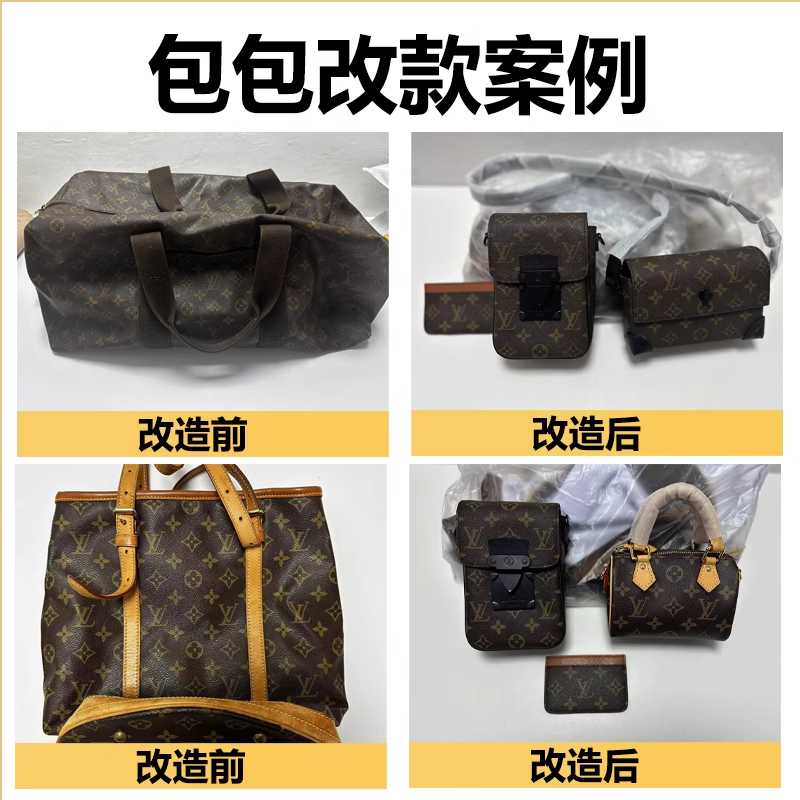
The Business Model: Up-cycling or Unauthorized Production?
The defendant, Shenzhen Bangtu, developed its business model around a concept that appears attractive at first glance. The company acquired second-hand luxury handbags, sometimes referring to them as waste. These genuine items underwent a process involving disinfection, dismantling (拆包), sourcing of materials, redesign, and ultimately, reassembly (再造). The final products were new handbags, whose external designs often closely resembled the classic shapes of the original luxury brands from which the materials were taken.
These recreated bags were then sold on various e-commerce platforms. The main issue of infringement centered on their presentation. On the most visible and prominent parts of these new bags—areas where consumers would typically expect to see the brand main logo—Shapeshift placed the iconic monograms and symbols of Louis Vuitton. In contrast, Shapeshift own registered trademark, Shapeshift, was barely noticeable, appearing only on minor parts such as zipper pulls and inside the bag lining.
When challenged by Louis Vuitton, Shapeshift offered a multi-layered defense. They claimed that their use of the Louis Vuitton marks did not constitute trademark use in the legal sense but was merely a decorative feature, representing only a small portion of the bag overall design. Their primary legal argument, however, was based on the doctrine of trademark exhaustion. Shapeshift argued that since the raw materials (the original bags) were authentic products already sold by Louis Vuitton, the company trademark rights had been exhausted, allowing Shapeshift to reuse these materials freely. They asserted that this practice embodied the principles of a circular economy. Additionally, they framed their entire business within the context of environmental policy, suggesting that a ruling against them would hinder progress toward sustainable development.
The Court Analysis: Why Trademark Exhaustion Did Not Apply
The courts carefully and thoroughly refuted each of Shapeshift claims. Their ruling serves as an excellent example of how fundamental trademark principles can be applied to a complex, contemporary case. The reasoning can be divided into two main, related areas: the nature of consumer confusion and the specific boundaries of the trademark exhaustion doctrine.
The Range of Confusion: Extending Beyond the Point of Purchase
The court took a modern and comprehensive approach to understanding consumer confusion. It rightly dismissed a narrow interpretation that focuses only on the initial buyer at the time of sale. Instead, it embraced a broader view familiar to luxury brands: considering the entire lifecycle of the product and how it is perceived by the public.
The judgment stated that for a trademark as famous and important as Louis Vuitton, the potential for confusion should not be limited just to the person who buys the product, nor confined to the moment of purchase. This recognizes the concept known in common law as post-sale confusion.
The court factual findings strongly support this. When a consumer buys one of Shapeshift bags, the outer packaging and product descriptions might briefly clarify its origin. However, once the product is in use, these identifiers are discarded. The consumer is left carrying a handbag in public that prominently displays the Louis Vuitton monogram, which clearly signals its supposed origin. Meanwhile, the Shapeshift mark, hidden on a zipper or inside a pocket, is not visible to others.
The result is inevitable. Friends, colleagues, passersby, and potential future customers will see the Louis Vuitton logo on a bag that is clearly different in quality and origin from an authentic Louis Vuitton product. This creates a halo effect, where Louis Vuitton reputation and goodwill are unfairly used to endorse Shapeshift product. More importantly, it breaks the unique, one-to-one relationship that Louis Vuitton has carefully established between its trademark and the goods it actually produces. This weakens the brand identity and can cause serious damage to its reputation if the quality of the recreated bag is inferior. The court rightly recognized that this ongoing post-sale confusion directly harms the trademark role as a source identifier.
The Revival of a Limited Right: The Doctrine Built-in Boundaries
Shapeshift case centered on the trademark exhaustion doctrine, making the court reasoning here especially important for brand owners. The court upheld the exhaustion principle—that once a trademark owner puts an authentic product on the market, they lose control over its resale. However, it introduced a crucial and practical limitation: this doctrine applies only to the resale of the original product in its unchanged form, not to its conversion into a completely new commercial item.
The ruling outlined key factors to consider when deciding if the exhaustion doctrine does not apply to goods that have been modified or re-manufactured.
a) The Same Product Criterion and the Substantial Alteration Test
The court primary and most important conclusion was that the bags sold by Shapeshift were not the same as those originally sold by Louis Vuitton. Shapeshift method of dismantling and reconstructing the bags amounted to a substantial alteration. The final products differed entirely in shape, color scheme, and overall look. The court even required Shapeshift to prove that its materials came from genuine products but clarified that even if this were true, it would not affect the decision.
This distinction is critical. The exhaustion doctrine is intended to enable the free flow of goods. It stops a trademark owner from preventing a retailer from selling an authentic handbag bought from an authorized source. However, it does not give a third party the right to use the trademarked product as raw material to make a new item. The analogy is straightforward: you can resell a used Mercedes-Benz car, but you cannot melt it down for scrap metal, use that metal to build a tractor, and then sell the tractor bearing the Mercedes-Benz logo. The product has been fundamentally transformed.
b) The Erosion of Trademark Functions
The court evaluation extended beyond just the physical alteration of the product to consider its effect on the fundamental nature of the trademark. It identified two primary functions that were harmed by Shapeshift’s conduct.
First, the function of source identification. By placing the Louis Vuitton trademark on items it neither produced nor controlled, Shapeshift created a misleading impression of origin. This action deceived the public and severed the clear connection between the Louis Vuitton trademark and products genuinely made by Louis Vuitton.
Second, and perhaps even more importantly for a luxury brand, the function of quality assurance. A trademark, especially in the luxury sector, represents more than a name; it embodies a promise. It signifies a guaranteed level of craftsmanship, materials, design, and quality control upheld by the brand owner. Shapeshift production methods, standards, and quality controls are completely independent from and unknown to Louis Vuitton.
By linking the Louis Vuitton trademark to its recreated bags, Shapeshift effectively appropriated this quality guarantee. This not only misleads consumers but also puts Louis Vuitton reputation at significant risk. Should a Shapeshift bag deteriorate, the harm to Louis Vuitton reputation for quality is genuine, despite Louis Vuitton having no involvement in its manufacture. The court wisely acknowledged that this resurrection of a right that would otherwise be exhausted was warranted to prevent such damage.
c) The Obligation of Transparency and Fair Competition
Lastly, the court addressed the principles of good faith and transparency. It observed that Shapeshift failed to clearly and prominently disclose that its products were recreated or re-manufactured. Moreover, it intentionally concealed its own brand identity while emphasizing the Louis Vuitton mark. This business tactic was not motivated by a desire to honor the original design but was a deliberate attempt to capitalize on Louis Vuitton substantial brand value. The ruling suggests that a more transparent approach—though still potentially infringing—might have been judged differently. The court proposed a legitimate method for up-cycling: removing or obscuring the original trademarks and clearly displaying the new creator brand, thereby preventing consumer confusion about the product true origin.
Key Strategic Insights for International Brand Owners
This landmark decision from the Zhejiang courts offers important strategic lessons for international brand owners operating in China:
- A Strong Judicial Partner: The ruling shows that China’s courts have a sophisticated grasp of trademark law. They acknowledge concepts such as post-sale confusion and the qualitative functions of trademarks, providing a solid legal framework to defend valuable brands against subtle, modern infringements.
- Trademark Exhaustion Is Not an Absolute Defense: Brand owners can be assured that the trademark exhaustion doctrine will not serve as a blanket defense for actions that significantly alter a product and harm the brand. The focus on substantial alteration and the revival of rights offers a powerful legal means to counter such practices.
- Stay Alert to New Forms of Infringement: This case underscores the importance of proactive market surveillance. Infringement now goes beyond obvious counterfeits. Brand owners must watch for business models that dismantle their products and misuse their intellectual property without authorization, especially in the growing market for second-hand and upcycled goods.
- Clear Criteria to Distinguish Partners from Infringers: The judgment provides a straightforward test to differentiate legitimate collaboration from infringement. A genuine partner will remove or conceal your trademarks and create their own brand identity. An infringer, like Shapeshift, will hide their own branding and prominently display yours to exploit your goodwill.
In summary, the Louis Vuitton v. Shapeshift case marks a pivotal moment. It is a judicial endorsement that, amid the evolving relationship between commerce, sustainability, and creativity, protecting a brand’s identity remains essential. For international brand owners, it confirms that their most valuable assets are being taken seriously and safeguarded, even when facing new and complex challenges.
If you have any legal inquires, please feel free to contact me at wenwen82cn@vip.163.com.