


Andrea_liang

A Tactical Guide to Fighting Against Copycats on Chinese E-commerce

Last week just before the Christmas holidays a Norwegian SME client has discovered counterfeit replicas of their products being sold on Chinese websites. Given that the client is seeking a prompt, effective, and cost-efficient solution rather than incurring high legal fees, how can we best address and resolve this e-commerce infringement issue? I. Protective Stronghold – Building the Client’s Legal Base Before taking any action, it’s essential to build a strong legal base. Success in the competitive landscape of Chinese e-commerce depends on having the proper legal rights to operate. The intellectual property registrations serve as both the client’s authorization to conduct business and the client’s tools for enforcement. This is an indispensable first step. Without a Chinese trademark certificate, the client cannot submit complaints on major platforms—it acts as the client’s enforcement passport. It’s important for the client to approach this process comprehensively and strategically. The client shouldn’t limit


Read More »
Andrea_liang

Enforcing Foreign Judgments in China: A Practical Guide for International Brand Owners

I recently handled a query from the legal department of a UK-based company, a situation that highlights a frequent procedural difficulty in the enforcement of international judgments. The UK company had successfully sued a Chinese company’s UK subsidiary and its Chinese parent entity in a UK court and obtained a favorable judgment. The current challenge they face is the practical matter of enforcing this judgment in China. The first step in the enforcement process—serving the relevant legal documents on the China-based respondent—is a statutory prerequisite for initiating the entire judicial proceeding. However, it is precisely this service step, due to its specialized and complex nature, that has become a common stumbling block for many overseas parties seeking judicial relief in China. China offers a powerful legal avenue for enforcing foreign court judgments. Yet, its legal system, grounded in the principle of national sovereignty, treats court judgments as territorial. This means

Read More »
Trademark Exhaustion
Andrea_liang

Deconstructing the Boundaries of Trademark Exhaustion in the Era of Up-cycled Luxury

In the luxury industry, the global growth of the circular economy and sustainable fashion presents a challenging dilemma. On one side, it supports corporate social responsibility objectives and appeals to a new generation of eco-conscious consumers. On the other side, it raises complex issues of potential intellectual property violations, where the boundary between legitimate reuse and brand exploitation becomes dangerously unclear. A recent, highly important ruling by Chinese courts has offered a landmark clarification on this matter, providing strong protection for brand integrity while addressing the complexities of modern business practices. The case, Louis Vuitton Malletier v. Shenzhen Bangtu Cultural Media Co., Ltd., was heard by the Hangzhou Intermediate Court and later upheld by the Zhejiang Provincial High Court. It dealt with a growing business model involving the purchase of second-hand luxury items, their dismantling, and their reassembly into new products for sale, all while prominently displaying the original brand

Read More »
Malicious Trademark Application China
Andrea_liang

Navigating the New Paradigm of Trademark Management in China

In recent years, Chinese trademark law has undergone a notable shift, with greater focus placed on the genuine use of trademarks. As a result, there has been a marked increase in cases where defensively registered trademarks have been cancelled due to lack of authentic commercial use. Registering and maintaining a trademark requires considerable time and financial resources, a challenge that is especially pronounced for companies managing large portfolios that may include hundreds or even thousands of marks. Consequently, effectively managing and “revitalizing” these inactive defensive trademarks has become a critical and urgent issue that calls for practical solutions. Many foreign trademark owners, however, have yet to fully recognize this change. They often hold onto the outdated notion that once a trademark is registered, it remains permanently protected—a “set-and-forget” asset. In reality, this mindset is no longer aligned with the current direction of China’s trademark policies. It is therefore essential for

Read More »
China Trademark Law
Andrea_liang

A Guide to Registering Trademarks with Foreign Country Names in China (Judgement Attached)

When assisting international companies entering the Chinese market, one of the most common and challenging issues we face involves registering trademarks that include or reference foreign country names. At first glance, the legal framework seems contradictory. Public campaigns and general knowledge of intellectual property law have taught many that a trademark identical or similar to the name of a foreign country shall not be used. This rule, enshrined in law, appears absolute. If such marks cannot be used, it logically follows that they cannot be registered either. However, a quick look at the Chinese market and global trade reveals many successful and seemingly conflicting examples. Trademarks like NATURAL POLAND (referring to Poland), American Standard (referring to the USA), and Guomei (a near reversal of the Chinese characters for America) are not only in use but have also been officially registered in China. This naturally raises a key question from clients:

Read More »
Non-Use Cancellation China
Andrea_liang

Tactical Trademark Guardianship: Safeguarding Your Brands from Che San Challenges in China

Following the discussion on essential trademark compliance—such as strict adherence to registered mark formats, statutory deadlines, and approved classification limits—this advisory focuses on the complex issue of maintaining defensive trademark registrations against Article 49 cancellations (Che San) under China Trademark Law. Although these registrations are not actively used in commerce, they play a vital strategic role in preventing brand dilution, deterring unauthorized use, and securing opportunities for future market growth. China Changing Trademark Non-Use Cancellation System:An In-Depth Review for Overseas Stakeholders Defending Trademark Non-use Cancellation The Legal Challenge and Our Solution China Che San provision requires cancellation of trademarks that have not been used for three consecutive years, aiming to remove inactive marks from the register. However, defensive registrations are typically not intended for traditional commercial use, which creates a conflict with the law use requirements. Conventional advice to fully commercialize these marks often proves impractical. After thorough review of

Read More »
Andrea_liang

Navigating Celebrity Portrait Rights in China

A recent inquiry from a client at a leading film production company highlighted a critical issue: How can the unique persona of a star character be protected within the film itself? This question moves beyond the simple use of a heads hot, touching upon the very essence of how a celebrity commercial value is created and monetized. While public figures naturally attract considerable attention, their right to control the use of their likeness—referred to as portrait rights—is firmly protected under Chinese law. This legal framework carefully balances individual rights with the public interest, and missteps in this area can lead to significant legal and financial consequences. Legal Framework: Protections and Boundaries China Civil Code provides the foundation for portrait rights protection. It defines a portrait as any recognizable external image of a specific individual, whether captured through photography, sculpture, painting, or other media. The critical legal test is identifiable—if the

Read More »
Andrea_liang

When the Shield Breaks: The New Age of Internet Liability

In recent years I have witnessed a significant and crucial transformation in the digital world. Core internet services—such as CDN acceleration, DNS resolution, and development frameworks—have traditionally operated under the principle of technical neutrality. This principle has long protected these infrastructure providers from being held directly responsible for the content they help deliver. They were seen as the digital equivalent of road builders, not accountable for the goods transported on their roads. However, this period of unquestioned protection is coming to an end. The digital environment has evolved into a complex, borderless network where illegal activities, especially large-scale copyright infringement, can thrive with increasing sophistication. The idea of technical neutrality is no longer an absolute defense but a nuanced argument that courts around the world are scrutinizing more closely. A landmark decision in November 2025 by the Tokyo District Court against Cloudflare—a company managing about 20% of global internet traffic—illustrates

Read More »
Andrea_liang

China New Guidelines on E-commerce Platforms and Trademark Infringement: Key Insights for International Businesses

Overview To tackle the increasing problem of trademark violations in China rapidly expanding e-commerce industry, the State Administration for Market Regulation (SAMR) has introduced draft regulations titled Regulations on E-commerce Platforms’ Assistance in Investigating and Handling Trademark Infringement Cases (Draft Regulations). This initiative supports China wider intellectual property (IP) protection goals outlined in the Outline of the National Intellectual Property Strategy (2021–2035) and directives from the Communist Party of China and State Council on strengthening IP enforcement. The Draft Regulations focus on closing enforcement loopholes, especially concerning ghost online stores — sellers using fake or untraceable information — which have complicated IP protection efforts. For foreign companies operating in or exporting to China, understanding these proposed rules is crucial for protecting trademark rights and navigating the changing regulatory environment. This article analyzes the background, main provisions, and practical effects of the Draft Regulations for international businesses. Background: The Need to

Read More »
Andrea_liang

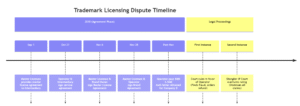
The Sub-Licensing Challenge in China: An Important Case Study Highlighting Risks in Foreign Brand Licensing

A recent decision by the Shanghai Intellectual Property Court offers a vital lesson for international brand owners and their Chinese partners. The court overturned a lower court ruling in a trademark licensing dispute (referred to here as the Brand A Case), dismissing the plaintiff claims entirely. This case, centered on a sub-licensing arrangement involving a foreign brand in China, exposes common legal pitfalls and provides valuable insights on structuring such agreements to minimize risk. As counsel for the successful party on appeal, I will review the key issues and share practical strategies for risk prevention. I. Overview of the Case In October 2018, the Operator (Party A) engaged an Intermediary (Party C) to facilitate a cooperation agreement with the owner of Brand A and authorized the Intermediary to handle payments on its behalf. In November 2018, the Master Licensee (Party B) entered into a License Agreement with the foreign Brand

Read More »

Subscribed

Recent Posts
Newsletter Signup Form
Hello, and thank you for your interest. Please be advised that this website is independently operated and managed by me personally, and all content is authored by myself. Due to the constraints of a one-person operation, my responses to subscription messages may occasionally be delayed. I appreciate your understanding. If you are interested in the content on this site, I encourage you to contact me directly via email wenwen82cn@vip.163.com. I will ensure that you receive the latest articles directly to your inbox as soon as they are published.